
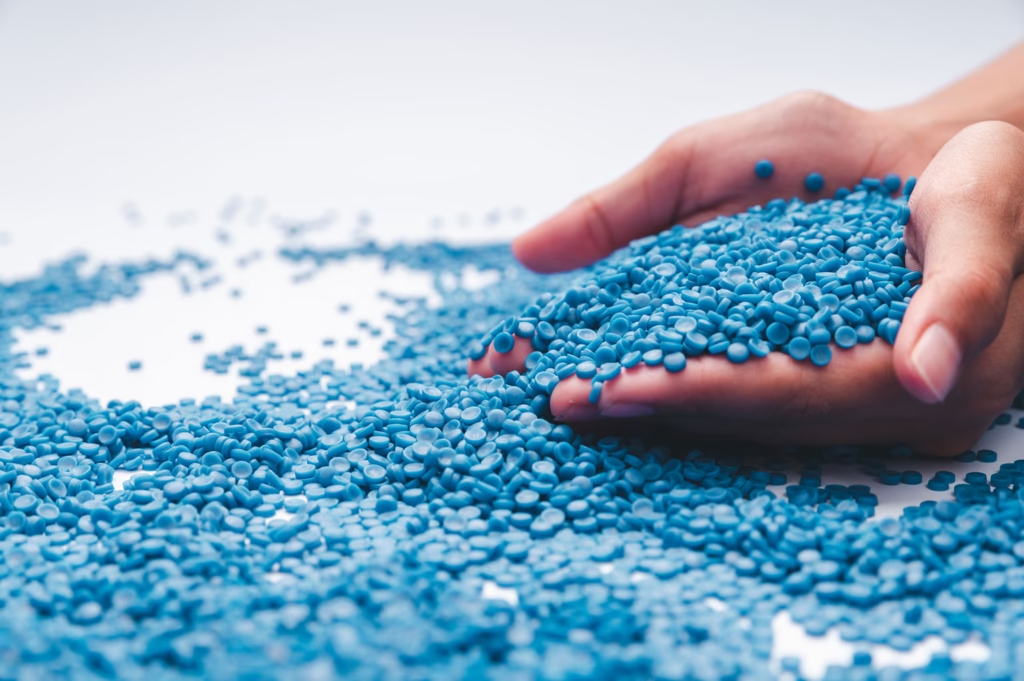
A crucial question in the circular economy is how to redirect plastic flows from energy recovery (i.e. incineration) to material recycling. According to the Swedish Environmental Protection Agency (Naturvårdsverket), at most 25 percent of all plastic placed on the market in 2023 was recycled—and the true figure was likely lower. From a macroeconomic perspective, there must be sufficiently strong demand for recycled plastic feedstock for this situation to change. For a long time, this challenge has been considered so complex that no implemented policy instruments or regulatory frameworks have been effective enough to address it. While several measures are now expected to come into force over the coming years, such as mandatory recycled content quotas, this can still be described as a true Gordian knot. For those unfamiliar with Greek mythology, a Gordian knot represents a complex, almost impossible to solve, problem that can only be solved in a surprisingly simple way through a drastic action (in the case of the Gordian knot, the decisive action required was Alexander’s sword stroke).
What could Alexander’s cut be in this case? Perhaps Trump and his war with Iran. The price of recycled raw materials is linked to the price of crude oil. Already now, the war has led to price increases for certain plastics, and for other fractions prices are expected to rise in the near term. The fastest price increases are observed for plastics that can be used for a wide range of products and where production is not sensitive to whether the feedstock is virgin or recycled. At the time of writing this, a fragile ceasefire has just begun. Naturally, the hope is that this leads to lasting peace. But even if that happens and oil prices settle at a structurally lower level, it is likely that the price for recycled raw materials will include a risk premium. Companies that reduce their dependence on virgin raw materials produced from crude oil and instead transition to recycled feedstock significantly reduce their business risks. After all, who knows when the next conflict will erupt and affect the availability of crude oil?
There is another aspect of recycled plastic flows that will need to be addressed moving forward, namely the survival of the European plastic recycling industry. China has not only taken enormous strides and moved far ahead of Europe in batteries, solar panels and electric vehicles; it also has the world’s largest plastic recycling industry. This has allowed China to build world-class expertise and invest heavily in the development of new technology. This strategy is part of China’s broader goal of reducing its dependence on imported oil. It is definitely positive that China is making a strong push to increase plastic circularity—but how does this affect Europe’s own plastics industry? One problem is that China sells recycled feedstock on the global market at low prices, thereby crowding out European plastic recyclers. One (for many reasons bad) solution could have been to export all our separately collected plastic waste to China and let them recycle it in larger and more advanced facilities. But that is not an option, since China introduced an import ban on waste in place several years ago.
The risk is that Europe will end up with large volumes of collected plastic waste and insufficient capacity to handle them. To avoid this catch‑22 situation, the EU must invest in the recycling industry. What needs to be done? First, some form of CO₂‑based tariff (such as a CBAM) should be introduced on imports of virgin plastic. Today, China and India produce plastics from residual gases from the refining of Russian oil, enabling them to dump prices for virgin plastic. A CO₂-based import duty would help create better price parity between virgin and recycled feedstock. In addition, financing solutions are needed to allow the European plastic recycling industry to upgrade and expand its facilities to a scale that delivers cost advantages. Today, many plants operate with outdated technology and are simply too small to be competitive. Furthermore, it is essential to ensure that companies using recycled plastics in their products and packaging are given advantages in procurement processes by both private and public buyers.
Plastic recycling is not a hot election issue, but perceptive policymakers should recognize that there is significant potential for action here. And companies with ambitious climate targets should realize that this is an area where they can make a real difference by designing products and packaging that can be manufactured from recycled materials.
Thanks to Linnea Granström, Climate and Environmental Strategist at Svensk Plaståtervinning, for insights into how the market is developing!
Malin Forsgren, Partner, 2050
This article is part of 2050 Highlights, a series where we explore pressing sustainability and business topics. Want to learn more about how your company can navigate the evolving regulatory landscape? Contact us at 2050!