
As regulations tighten and transparency across global value chains increases, expectations for responsible business conduct are rising – among customers, investors and business partners alike. Companies that take an early, proactive approach to reviewing their business relationships and embedding responsibility into their governance structures are better prepared for customer dialogues and procurement processes – while also strengthening their competitive edge.
Traditionally, many companies have seen sustainability management mainly as risk avoidance, a way to prevent non-compliance or negative environmental impacts. Today, however, more and more companies are discovering the business value that proactive and prioritized risk management can bring. Failing to act on risks in time often leads to unnecessary rework, higher costs, and damaged trust. By systematically mapping operations, suppliers, and other business relationships, companies can identify social and environmental risks early, which helps to prevent production disruptions, legal action, and reputational damage. For companies producing in or sourcing from higher-risk countries, it is especially important to be able to demonstrate how human rights and environmental risks are continuously assessed and managed throughout the supply chain. Due diligence is not only about mitigating risk; it is also about turning risk into opportunity. Active supplier dialogue and preventive action foster long-term, reliable relationships that strengthen both brand credibility and business resilience.
A new era of accountability
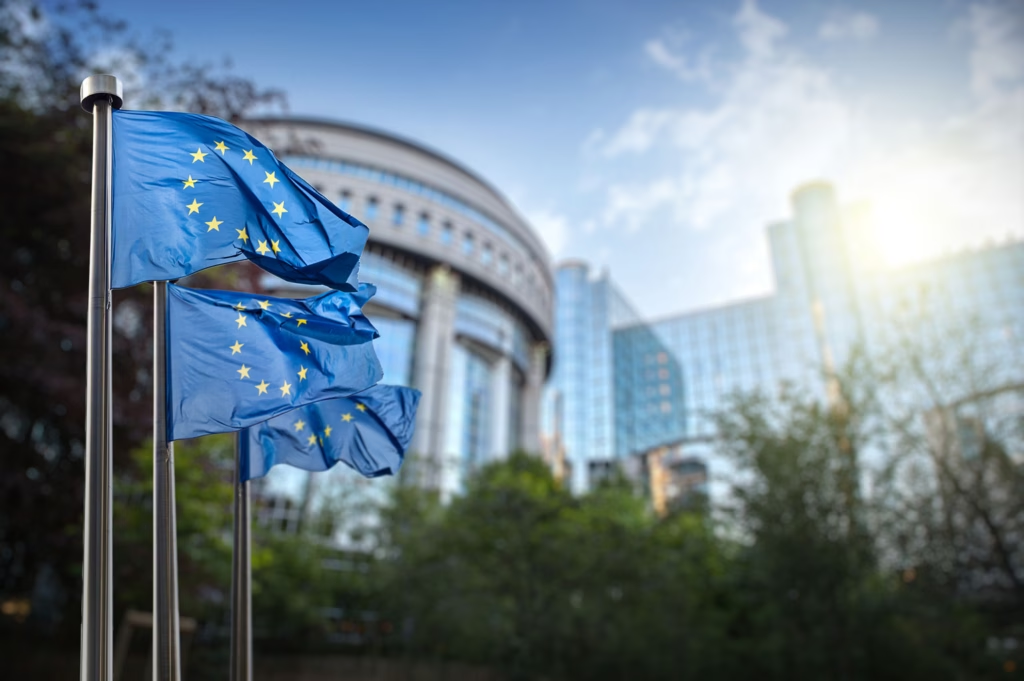
Large companies have long worked to ensure due diligence in their supply chains, building systems to identify and prevent human rights violations and environmental harm. With the upcoming EU Corporate Sustainability Due Diligence Directive (CSDDD), such sustainability risk assessments will become a legal requirement, including an obligation to remediate negative impacts, for example, through financial compensation. The new legislation also requires companies to report on how they follow up on their due diligence processes and how they address identified risks. Similarly, the EU Taxonomy’s minimum safeguards demand that companies implement processes to ensure compliance with basic social and environmental standards.
Risk mapping is also a key element of the Corporate Sustainability Reporting Directive (CSRD), which builds on the OECD Guidelines for Multinational Enterprises. Two other upcoming EU regulations that will also require companies to assess risks in their value chains include the EU Deforestation Regulation (EUDR), which is proposed to take effect in 2026 for larger companies, and the EU Forced Labour Regulation (EUFLR), which is expected to apply to companies of all sizes from 2027.
Whether or not your company is formally covered, the direction is clear: responsible business is becoming the new minimum standard.
Why now?
Stricter regulations are one reason to start working more systematically on value chain risk management. But there is also a clear market push, as fair business practices and due diligence processes are now standard requirements in tenders and major customer contracts.
For large businesses, due diligence is all about partnership. If you are a supplier to a larger company, you are part of that company’s sustainability footprint and its risk exposure as well.
How to get started
A good starting point for assessing sustainability risks in your operations, products, and services is the double materiality assessment required by CSRD. Step one is to conduct a stakeholder and context analysis, mapping out key stakeholders such as customers, investors, employees, suppliers, authorities, and civil society actors. Stakeholders provide valuable insight into risks, for instance related to working conditions or environmental impacts, and also into potential opportunities for innovation and collaboration. These insights form the foundation for refining your company’s materiality and risk assessment, helping you focus on the issues most relevant to both your business and your stakeholders.
Four ways to turn due diligence into business advantage
- Identifying risks early – fewer disruptions, lower costs, and a stronger reputation.
- Prioritizing critical risks – focus resources where they make the biggest difference and stay agile in times of change.
- Building resilience and competitiveness – proactive analysis ensures operational reliability, stronger performance, and a better negotiating position.
- Creating business value – stronger performance in tenders, enhanced brand trust, and more room for innovation and product development.
Code of Conduct as a driving force
Most companies already have a Code of Conduct; a simple way to set out values, ethics, and expectations for behavior. It is also the perfect starting point for weaving sustainability and risk management into daily operations.
If your company does not have a Code of Conduct yet, it is worth putting one in place. It clarifies what responsible business really means — for you, your suppliers, and your partners — and helps translate those principles into daily work across procurement, HR, sales, and finance. It also keeps reporting and follow-up connected to management decisions.
How to succeed
The key is to treat due diligence as a strategic business process rather than just another reporting task, and to shift focus from risk to results. With proactive supplier dialogue, preventive actions, and AI-supported mapping, companies can improve working conditions, reduce environmental impact, and build long-term, trusted partnerships.
Smart, prioritized risk management helps businesses focus their efforts where it makes the biggest difference – driving value, resilience, and trust.
At 2050, we believe that due diligence is not about box-ticking. It is about creating stronger companies – ones that are ready for change, trusted by their partners, and equipped to turn responsibility into real results.
Lina Wing
Consultant specializing in CSRD and materiality assessment, 2050 Consulting
Leila El-Sherif Wollheim
Senior Consultant specializing in social sustainability, 2050 Consulting
This article is part of 2050 Highlights, a series where we explore pressing sustainability and business topics. Want to learn more about how your company can navigate the evolving regulatory landscape? Contact us at 2050!